
Report overview
The India Pet Wearables Market is witnessing significant growth, driven by increasing pet ownership, rising expenditure on pet healthcare, and growing awareness regarding pet safety and fitness. Wearable technologies such as GPS trackers, smart collars, activity monitors, and health monitoring devices are becoming increasingly popular among urban pet owners seeking real-time insights into their pets’ well-being.
The market is supported by rapid advancements in IoT, artificial intelligence, and mobile connectivity, enabling manufacturers to introduce innovative products with enhanced tracking, health diagnostics, and behavioral monitoring capabilities. The expansion of e-commerce platforms and premium pet care services has further improved product accessibility across metropolitan and Tier I cities.
This survey report analyzes consumer preferences, purchasing behavior, awareness levels, adoption trends, key purchasing factors, and future demand outlook for pet wearables in India. The findings provide valuable insights for manufacturers, distributors, retailers, investors, and technology providers operating within the pet technology ecosystem.
What you get
Report Coverage
Verified Market Sizing
Multi-layer forecasting with historical data and 5–10 year outlook
Deep-Dive Segmentation
Cross-sectional analysis by product type, end user, application and region
Competitive Benchmarking & Positioning
Market share, operating model, pricing and competition matrices
Actionable Insights & Risk Assessment
High-growth white spaces, underserved segments, technology disruptions and demand inflection points
Free preview
See What's Inside the Report
Preview key findings, methodology & report coverage
Executive summary
The India Pet Wearables Market is experiencing robust growth, supported by the increasing trend of pet humanization, rising disposable incomes, and greater awareness of preventive pet healthcare. As companion animals become integral members of Indian households, pet owners are increasingly investing in smart pet wearables that offer real-time location tracking, activity monitoring, and health management. These innovations are transforming how owners monitor their pets while creating new opportunities for manufacturers, technology providers, and pet care brands.
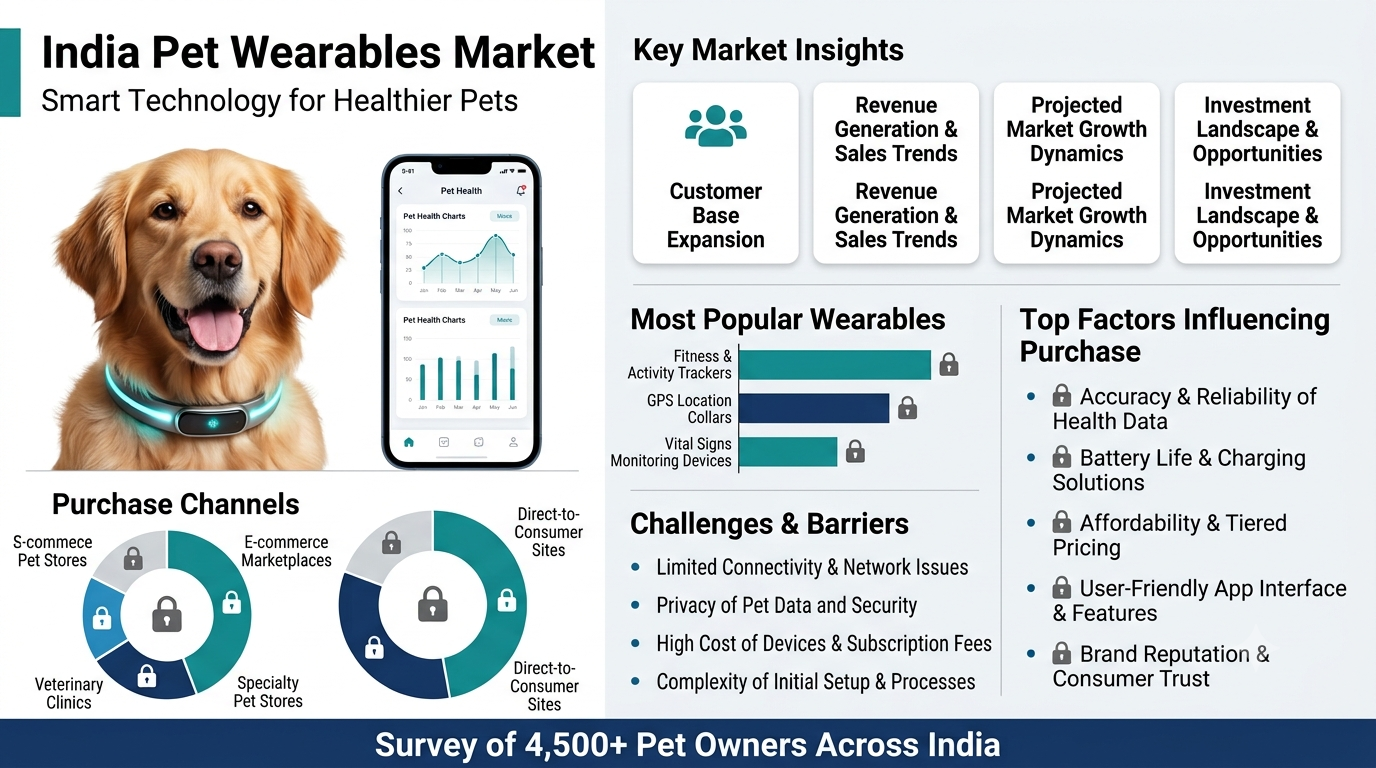
Consumer awareness of GPS pet trackers, smart dog collars, smart cat collars, and AI-enabled health monitoring devices has grown considerably in urban India. Among available product categories, GPS-enabled collars remain the most widely recognized due to their ability to improve pet safety and reduce the risk of pets getting lost. At the same time, wearable devices capable of tracking physical activity, sleep quality, calorie expenditure, heart rate, and overall wellness are gaining popularity among health-conscious pet owners seeking preventive care solutions.
The survey findings indicate that purchasing decisions are influenced by several factors, including tracking accuracy, battery life, durability, mobile application functionality, subscription costs, and after-sales support. Consumers also value waterproof designs, lightweight construction, long battery performance, and seamless smartphone integration when selecting wearable devices. As competition intensifies, manufacturers are focusing on product innovation, user-friendly interfaces, and data-driven health insights to differentiate their offerings.
Online retail platforms continue to dominate sales of pet wearable devices in India, providing consumers with convenient product comparisons, customer reviews, and competitive pricing. Specialty pet stores and veterinary clinics remain important offline channels, particularly for premium and health-focused wearable products. The growing penetration of e-commerce and digital payment infrastructure is expected to further strengthen product accessibility across metropolitan, Tier I, and emerging Tier II cities.
Despite the positive market outlook, certain challenges continue to affect adoption. Higher product prices, limited awareness among first-time pet owners, recurring subscription fees for advanced tracking services, and concerns regarding battery life remain notable barriers. However, increasing education about pet wellness, continuous technological advancements, and expanding availability of affordable wearable solutions are expected to improve market penetration over the coming years.
Overall, the India Pet Wearables Market is positioned for sustained expansion, driven by advancements in IoT, artificial intelligence, cloud connectivity, and mobile technologies. As consumers increasingly prioritize pet safety, health monitoring, and connected lifestyles, demand for intelligent wearable solutions is expected to rise steadily. The survey findings highlight a favorable long-term outlook, making the market attractive for manufacturers, distributors, retailers, investors, and other stakeholders seeking growth opportunities within India’s evolving pet technology ecosystem.
Table of contents
1. Report Overview
2. Executive Summary
3. Introduction to the India Pet Wearables Market
- 3.1 Market Definition
- 3.2 Scope of the Study
- 3.3 Types of Pet Wearable Devices
- 3.4 Applications of Pet Wearables
- 3.5 Industry Value Chain
4. Research Objectives
- 4.1 Primary Objectives
- 4.2 Secondary Objectives
- 4.3 Key Research Questions
5. Research Methodology
- 5.1 Research Design
- 5.2 Sample Size and Respondent Profile
- 5.3 Data Collection Methods
- 5.4 Survey Questionnaire Design
- 5.5 Data Validation and Quality Checks
- 5.6 Data Analysis Techniques
- 5.7 Study Limitations
6. Respondent Demographics
- 6.1 Age Group Distribution
- 6.2 Gender Distribution
- 6.3 Monthly Household Income
- 6.4 Occupation
- 6.5 Geographic Distribution
- 6.6 Type of Residential Area (Urban, Semi-Urban, Rural)
7. Pet Ownership Profile
- 7.1 Type of Pets Owned
- 7.2 Number of Pets per Household
- 7.3 Duration of Pet Ownership
- 7.4 Average Monthly Spending on Pets
- 7.5 Frequency of Veterinary Visits
8. Awareness of Pet Wearables
- 8.1 Awareness Level by Device Type
- 8.2 Sources of Product Awareness
- 8.3 Awareness by Age Group
- 8.4 Awareness by Income Level
9. Adoption of Pet Wearables
- 9.1 Current Ownership of Pet Wearables
- 9.2 Adoption Rate by Pet Type
- 9.3 First-Time vs. Repeat Buyers
- 9.4 Duration of Device Usage
10. Usage Patterns and Consumer Behavior
- 10.1 Primary Purpose of Using Pet Wearables
- 10.2 Daily Usage Frequency
- 10.3 Most Frequently Used Features
- 10.4 Mobile App Usage Behavior
- 10.5 Data Monitoring Habits
11. Preferred Types of Pet Wearable Devices
- 11.1 GPS Tracking Collars
- 11.2 Activity and Fitness Trackers
- 11.3 Health Monitoring Wearables
- 11.4 Smart ID Tags
- 11.5 Training and Behavior Monitoring Devices
12. Purchase Decision Factors
- 12.1 Tracking Accuracy
- 12.2 Battery Life
- 12.3 Durability and Waterproof Design
- 12.4 Mobile App Compatibility
- 12.5 Brand Reputation
- 12.6 Product Price
- 12.7 Subscription Costs
- 12.8 Customer Reviews and Ratings
- 12.9 Warranty and After-Sales Service
13. Purchasing Channels
- 13.1 E-commerce Platforms
- 13.2 Brand Websites
- 13.3 Pet Specialty Stores
- 13.4 Veterinary Clinics
- 13.5 Electronics Retail Stores
14. Consumer Spending Analysis
- 14.1 Average Purchase Price
- 14.2 Preferred Price Range
- 14.3 Annual Spending on Wearables
- 14.4 Willingness to Pay for Premium Features
15. Customer Satisfaction Analysis
- 15.1 Satisfaction with Product Performance
- 15.2 Satisfaction with Mobile Applications
- 15.3 Satisfaction with Battery Performance
- 15.4 Customer Support Experience
- 15.5 Likelihood to Recommend
16. Challenges and Adoption Barriers
- 16.1 High Product Cost
- 16.2 Limited Consumer Awareness
- 16.3 Battery and Charging Concerns
- 16.4 Subscription Fee Concerns
- 16.5 Device Accuracy Issues
- 16.6 Privacy and Data Security Concerns
17. Emerging Trends in the India Pet Wearables Market
- 17.1 AI-Powered Health Monitoring
- 17.2 IoT-Enabled Smart Pet Ecosystem
- 17.3 Integration with Veterinary Services
- 17.4 Subscription-Based Digital Services
- 17.5 Growth of Premium Pet Technology
18. Future Purchase Intentions
- 18.1 Intention to Purchase Within 12 Months
- 18.2 Preferred Upcoming Features
- 18.3 Expected Budget Allocation
- 18.4 Factors Driving Future Adoption
19. Regional Analysis
- 19.1 North India
- 19.2 South India
- 19.3 East India
- 19.4 West India
- 19.5 Tier I vs. Tier II Cities
20. Competitive Landscape
- 20.1 Brand Awareness
- 20.2 Most Preferred Brands
- 20.3 Brand Comparison by Features
- 20.4 Consumer Loyalty Analysis
- 20.5 Opportunities for New Market Entrants
21. Key Survey Findings
22. Strategic Recommendations
- 22.1 Recommendations for Manufacturers
- 22.2 Recommendations for Retailers
- 22.3 Recommendations for Technology Providers
- 22.4 Growth Opportunities for Investors
23. Conclusion
Research Methodology
This survey report on the India Pet Wearables Market is based on a structured research framework designed to evaluate consumer awareness, purchasing behavior, product adoption, usage patterns, and future demand for pet wearable devices across India. The methodology combines quantitative research techniques with systematic data validation to ensure reliable and actionable insights for industry stakeholders.
5.1 Research Design
The study adopts a descriptive cross-sectional survey design to understand current consumer perceptions and market dynamics. The research focuses on identifying key trends influencing the adoption of smart pet wearables, including GPS trackers, activity monitors, health monitoring devices, and smart collars for companion animals.
5.2 Research Objectives
The primary objectives of the survey include:
- Assess consumer awareness of pet wearable technologies.
- Measure adoption rates among Indian pet owners.
- Understand purchasing preferences and buying behavior.
- Identify the most preferred types of pet wearable devices.
- Evaluate the factors influencing purchase decisions.
- Examine customer satisfaction with existing wearable products.
- Identify barriers preventing wider adoption.
- Analyze future purchase intentions and emerging market opportunities.
5.3 Target Respondents
The survey targets pet owners residing across India, including owners of dogs, cats, and other companion animals. Respondents represent diverse demographic segments based on:
- Age group
- Gender
- Household income
- Occupation
- Geographic region
- Urban, semi-urban, and rural residence
- Type and number of pets owned
5.4 Sampling Method
A non-probability sampling approach was utilized to collect responses from eligible participants who currently own pets or have expressed interest in purchasing pet wearable devices. The sampling strategy aimed to capture diverse consumer opinions from different socioeconomic backgrounds and geographic locations.
5.5 Data Collection Method
Primary data was collected through a structured online questionnaire distributed via digital survey platforms, social media communities, pet owner forums, veterinary networks, and email invitations. The questionnaire included multiple-choice questions, rating scales, ranking questions, and opinion-based responses to capture both behavioral and preference-related insights.
5.6 Questionnaire Structure
The questionnaire was organized into the following sections:
- Respondent demographics
- Pet ownership profile
- Awareness of pet wearables
- Current adoption and usage
- Preferred wearable device categories
- Purchase decision factors
- Spending behavior
- Purchase channels
- Customer satisfaction
- Adoption barriers
- Future buying intentions
5.7 Data Validation
To improve data quality, responses underwent multiple validation procedures, including:
- Duplicate response removal
- Incomplete questionnaire screening
- Logical consistency checks
- Response quality verification
- Data cleansing and standardization
Only verified responses meeting the study criteria were included in the final analysis.
5.8 Data Analysis
Collected responses were analyzed using descriptive statistical techniques to identify market trends and consumer behavior. Cross-tabulation and segmentation analysis were performed across demographic groups, income levels, pet ownership profiles, and geographic regions to identify meaningful patterns and market opportunities.
5.9 Study Scope
The report evaluates consumer perspectives regarding pet wearable devices available in the Indian market, including:
- GPS tracking collars
- Smart pet collars
- Activity and fitness trackers
- Health monitoring wearables
- Smart identification tags
- Behavior monitoring devices
The study examines awareness, adoption, purchasing behavior, satisfaction levels, and future demand without estimating company revenues or financial performance.
5.10 Study Limitations
While every effort has been made to ensure data accuracy, the findings should be interpreted considering the following limitations:
- Results represent consumer responses collected during the survey period.
- Consumer preferences may evolve as technology advances.
- Regional representation may vary depending on survey participation.
- Market conditions, pricing, and product availability may change over time.
- The report reflects consumer perceptions and should not be interpreted as a forecast of actual sales or market size.
5.11 Ethical Considerations
The survey was conducted following standard research ethics and data privacy practices. Participation was voluntary, respondent identities remained confidential, and all responses were aggregated solely for analytical purposes. No personally identifiable information was disclosed or used beyond the scope of this research.
FAQs
24.1 What are pet wearables?
Pet wearables are smart electronic devices designed for companion animals to monitor their location, health, activity, and overall well-being. Common products include GPS tracking collars, activity trackers, health monitoring devices, smart identification tags, and behavior monitoring wearables that connect to mobile applications for real-time insights.
24.2 What factors are driving the growth of the India Pet Wearables Market?
The market is primarily driven by increasing pet ownership, the growing trend of pet humanization, rising awareness of preventive pet healthcare, higher disposable incomes, and continuous advancements in technologies such as the Internet of Things (IoT), artificial intelligence (AI), and cloud connectivity. The rapid expansion of e-commerce platforms has also improved the accessibility of pet wearable products across India.
24.3 Which types of pet wearables are most popular among Indian consumers?
GPS tracking collars remain the most widely adopted category due to their ability to enhance pet safety and location tracking. Other popular products include activity and fitness trackers, health monitoring wearables, smart ID tags, and behavior monitoring devices that help owners monitor their pets’ daily activities and overall health.
24.4 Which factors influence consumers when purchasing pet wearable devices?
Consumers typically evaluate products based on tracking accuracy, battery life, durability, waterproof design, ease of use, mobile application compatibility, subscription costs, product price, brand reputation, customer reviews, warranty coverage, and after-sales service before making a purchase decision.
24.5 Where do Indian consumers usually purchase pet wearables?
Most consumers purchase pet wearables through online marketplaces, official brand websites, pet specialty stores, veterinary clinics, and selected electronics retailers. Online channels continue to dominate due to wider product selection, competitive pricing, customer reviews, and convenient home delivery.
24.6 What challenges affect the adoption of pet wearables in India?
Key challenges include relatively high product prices, limited awareness among first-time pet owners, recurring subscription fees for premium services, battery life concerns, and uncertainty regarding the long-term value of advanced wearable technologies.
24.7 How are smart technologies influencing the pet wearables industry?
Technologies such as IoT, AI, Bluetooth, GPS, and cloud computing are enabling manufacturers to develop intelligent wearables capable of real-time location tracking, health monitoring, activity analysis, behavioral insights, and predictive health alerts, enhancing the overall pet ownership experience.
24.8 Which consumer groups are most likely to adopt pet wearables?
Urban households, millennials, Gen Z consumers, dual-income families, and premium pet care customers are among the most active adopters of smart pet wearables. These groups generally place greater emphasis on pet safety, wellness, convenience, and connected lifestyle solutions.
24.9 What opportunities exist for businesses operating in the India Pet Wearables Market?
Manufacturers, technology companies, retailers, veterinary service providers, and investors can benefit from opportunities such as developing AI-enabled health monitoring devices, expanding affordable product offerings, strengthening omnichannel distribution networks, enhancing mobile applications, and integrating wearable data with veterinary healthcare services.
24.10 What is the future outlook for the India Pet Wearables Market?
The market is expected to witness sustained growth as consumer awareness increases, connected technologies become more affordable, and demand for preventive pet healthcare continues to rise. Innovations in smart collars, health monitoring systems, GPS tracking devices, and AI-powered analytics are expected to support broader adoption and create new growth opportunities across the Indian pet care ecosystem.
Report Licensing
choose the access that fits your team
-
Complete (PDF + Excel) $4000
Full report + data workbook
-
Report $3000
PDF version
-
Data Pack (Excel only) $2500
Market data & forecast workbook
Need specific chapters?
Request custom research →
-
Complete (PDF + Excel) $4000
Full report + data workbook
-
Report $3000
PDF Version
-
Data Pack (Excel only) $2500
Market data and forecast workbook